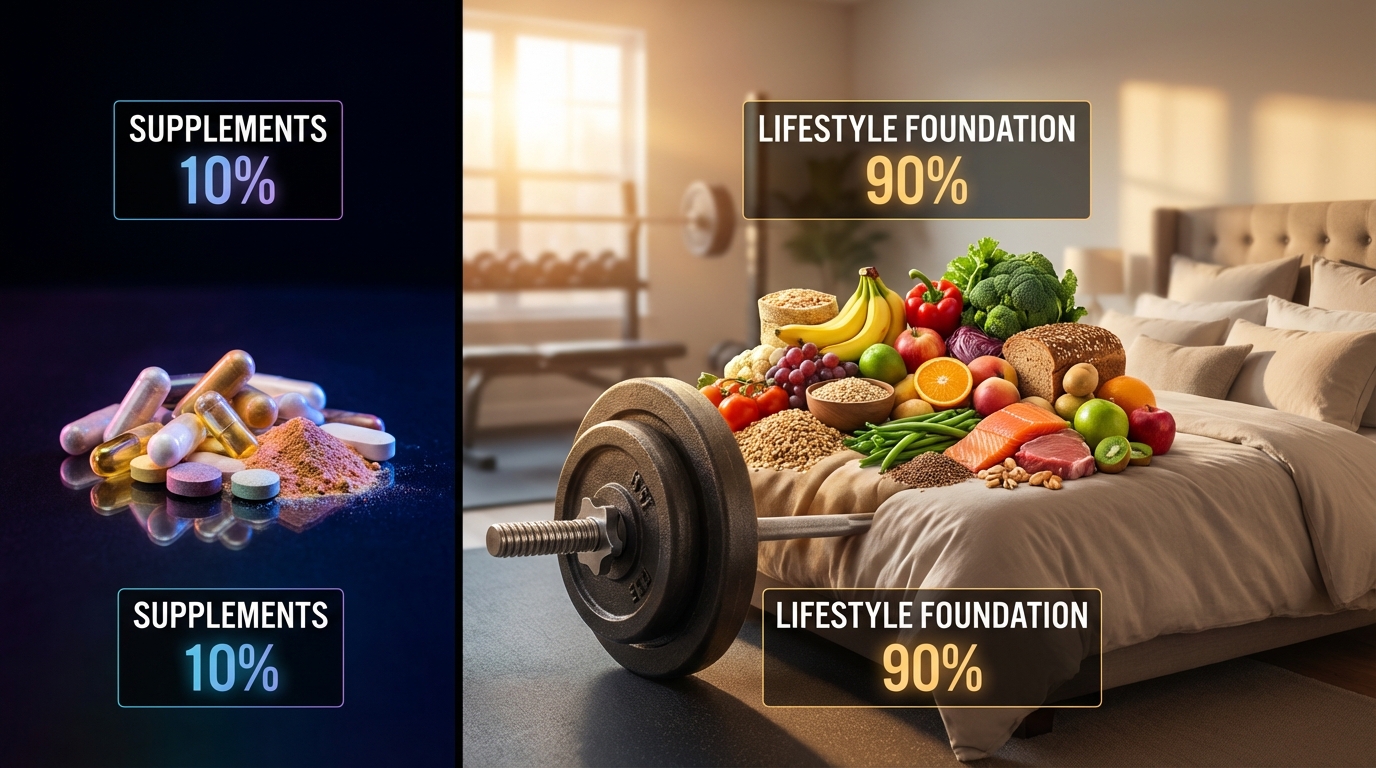
Supplements Are 10% of Fitness: Are You Ignoring the Other 90%?

The fitness industry is a multi-billion-dollar marketing machine. Every day, we are bombarded with advertisements for the latest fat burners, pre-workouts, mass gainers, and proprietary blends promising to unlock our ultimate physical potential. These campaigns are designed to create an illusion: the idea that a sculpted physique, boundless energy, and elite health can be found at the bottom of a plastic tub.
But the reality of human physiology is far less glamorous and far more demanding. You cannot out-supplement a bad routine. If you are relying on pills and powders while neglecting your diet, half-assing your workouts, and sleeping four hours a night, you are simply treating a symptom while ignoring the disease.
Supplements are exactly what their name implies—they are meant to supplement an already robust routine. They are the cherry on top of the sundae. If you haven't built the sundae, you just have a cherry sitting on an empty plate. To achieve real, lasting transformations, you must master the 90%: your nutrition, your training, your recovery, and your mindset.
The Foundation: Whole Food Nutrition (30%)
Before you ever consider buying a tub of whey protein or a branched-chain amino acid (BCAA) complex, you must address the absolute bedrock of human performance: what you put on your plate. Nutrition dictates your body composition, your energy levels, and your ability to recover from intense physical stress.
Prioritizing Macronutrients and Caloric Balance
The most critical factor in changing your body is understanding energy balance. If you want to lose weight, you must be in a caloric deficit. If you want to gain muscle, you generally need to be in a caloric surplus. No "fat-burning" supplement can override the laws of thermodynamics.
Once calories are set, your macronutrients—protein, carbohydrates, and fats—dictate the quality of your weight change. Protein provides the building blocks for muscle repair; carbohydrates supply the glycogen needed for high-intensity training; and dietary fats are essential for hormonal regulation, including testosterone production. Getting these variables right through real food is infinitely more powerful than any powder on the market.
Why Real, Nutrient-Dense Foods Fuel Performance Better
Whole foods provide a complex matrix of micronutrients—vitamins, minerals, antioxidants, and fiber—that simply cannot be perfectly replicated in a lab. An apple provides fiber that slows the absorption of its sugars, preventing an insulin spike. A steak provides bioavailable iron, zinc, and B-vitamins alongside its protein. Understanding the role of nutrition in achieving fitness goals is about recognizing that food is information, telling your cells how to behave, repair, and grow.
Hydration: The Ultimate Free Performance Enhancer
It is astonishing how many athletes will spend hundreds of dollars on supplements but walk around in a state of chronic, mild dehydration. Water is the medium in which all cellular reactions occur. A mere 2% drop in hydration can lead to a 10-20% drop in physical and cognitive performance. Proper hydration lubricates joints, aids in nutrient transport, and regulates body temperature during intense training.
- Nail Your Calories: Track your intake for a week to understand your baseline before trying to change it.
- Prioritize Protein: Aim for 0.8 to 1 gram of protein per pound of target body weight, primarily from whole food sources.
- Drink More Water: Aim for at least half your body weight in ounces of water daily, more if you are training heavily.
The Engine: Progressive Overload Training (30%)

If nutrition is the fuel, training is the engine. The human body is highly adaptive, but it is also incredibly lazy. It will not build metabolically expensive muscle tissue unless it is absolutely forced to do so. This is where the principle of progressive overload comes into play.
Forcing Adaptation Through Challenge
To change your physique, you must subject your muscles to a stimulus they are unaccustomed to. This creates micro-tears in the muscle fibers and triggers a metabolic response. When the body recovers, it builds the muscle back slightly larger and stronger to handle that stress better next time. If you go to the gym and lift the same weights, for the same number of reps, with the same rest periods month after month, your body has no reason to change.
Tracking Workouts and Increasing Volume
The only way to ensure you are applying progressive overload is to track your workouts. A simple notebook or an app on your phone is your greatest tool for muscle growth. You must strive to do slightly more over time—whether that means adding five pounds to the bar, performing one more rep, or improving your technique and range of motion. If you find yourself stuck, learning how to avoid fitness plateaus through strategic programming is vastly more effective than switching your pre-workout brand.
The Pre-Workout Illusion
Pre-workout supplements are incredibly popular because they provide an immediate, tangible feeling—usually a massive rush of caffeine and the skin-tingling sensation of beta-alanine. But feeling energized is not the same as doing the work. A pre-workout drink cannot lift the barbell for you, it cannot correct your form, and it cannot force a muscle to grow. Genuine physical effort and focused intensity are irreplaceable.
"You can have the most scientifically advanced supplement stack in the world, but if you train like a kitten, you will look like a kitten. The magic is in the work, not the powder."
The Unsung Hero: Sleep and Recovery (20%)

Our hustle culture often glorifies sleep deprivation. We wear "Team No Sleep" as a badge of honor, waking up at 4:00 AM to grind in the gym. But biologically speaking, sacrificing sleep for exercise is taking one step forward and two steps back.
Muscle is Built in Bed
When you are in the gym lifting heavy weights, you are not building muscle—you are actively breaking it down. The gym is merely the stimulus. The actual growth, repair, and adaptation happen when you are resting, specifically when you are asleep. If you shortchange your sleep, you are shortchanging your results.
The Massive Hormonal Impact of 7-9 Hours
During the deep stages of non-REM sleep, your body releases the vast majority of its daily human growth hormone (HGH). This hormone is critical for tissue repair and fat metabolism. Furthermore, chronic sleep deprivation leads to elevated levels of cortisol (a stress hormone that breaks down muscle) and a significant drop in testosterone. The importance of sleep for athletes cannot be overstated; it is the ultimate, natural performance-enhancing state.
Active Recovery and Stress Management
Recovery isn't just about lying in bed. It involves managing the cumulative stress of your daily life. High emotional or psychological stress taxes the central nervous system just as heavily as a heavy deadlift session. Integrating active recovery—like light walking, yoga, or mobility work—helps increase blood flow to recovering muscles without adding systemic fatigue.
The Glue: Consistency and Mindset (10%)
You can have the perfect diet, a scientifically optimized training program, and nine hours of sleep, but if you only do these things for two weeks, nothing will change. Consistency is the glue that binds the entire process together.
Showing Up Without Motivation
Motivation is an emotion, and like all emotions, it is fleeting. There will be days when you are tired, the weather is terrible, and the last thing you want to do is go to the gym or prep a healthy meal. The people who succeed in fitness are not constantly motivated; they are disciplined. They show up and do the work precisely on the days they don't feel like it.
Building Long-Term Lifestyle Habits
The fitness industry loves to sell 30-day shreds and 6-week transformations. But true health is not a sprint; it is a lifelong marathon. Focus on building sustainable habits that last rather than seeking rapid, temporary fixes. If a diet or training routine is so extreme that you can't imagine doing it a year from now, it is the wrong approach.
Patience and Delayed Gratification
In a world of next-day delivery and instant streaming, fitness remains one of the few domains where you cannot buy your way to the finish line. It requires patience and the willingness to delay gratification. Embrace the slow, steady progress. A 1% improvement every day compounds into massive transformation over a year.
Where Supplements Actually Fit In (The Final 10%)
If you have mastered the 90%—you are eating well, training hard, sleeping adequately, and staying consistent—then, and only then, do supplements make sense. At this stage, they can help optimize an already solid routine and push you past your natural ceiling.
The Evidence-Based Shortlist
The vast majority of supplements on the market lack robust scientific backing. However, there is a shortlist of highly researched, effective supplements that are worth your money:
- Creatine Monohydrate: The most researched sports supplement in history. It helps your muscles produce energy during heavy lifting, leading to increased strength and muscle volume.
- Whey Protein: Not a magic muscle builder, but an incredibly convenient and highly bioavailable way to hit your daily protein targets.
- Caffeine: A proven ergogenic aid that reduces perceived exertion and increases power output when used responsibly.
Identifying Specific Nutritional Gaps
Other supplements should be used specifically to fill gaps in your diet. If you live in a cold climate with little sun, Vitamin D3 is essential. If you rarely eat fatty fish, an Omega-3 fish oil supplement can support joint and cardiovascular health. If your bloodwork shows a deficiency, supplement accordingly. Do not supplement blindly.
Avoiding the "Shiny Object Syndrome"
It is easy to get caught up in the hype of exotic new supplements claiming to boost testosterone by 500% or melt fat while you sleep. Recognize these for what they are: marketing copy designed to separate you from your money. Stick to the basics, trust the science, and ignore the noise.
Stop Wasting Money and Start Building Habits
Focus on the 90% that truly matters. Stop searching for the magic pill and start laying the foundation for lifelong strength, health, and vitality. Join our community to get weekly, no-nonsense tips on training, nutrition, and recovery delivered straight to your inbox.
Join the Community TodayShare this content:
Discover more from J and J Health
Subscribe to get the latest posts sent to your email.